Our story
What a chemotherapy chair teaches you.
You learn patience. The infusion takes hours. The pump hums. Nurses move between patients with a calm that you eventually absorb. You have nowhere to be except here, in this chair, with this IV, while a drug that someone spent decades developing drips into your bloodstream.
You learn gratitude. Research made that drug. Patients before you contributed to the studies that proved it works. The treatment that's keeping you alive exists because of a chain of effort that stretches back further than you can see.
My name is Dhruv Deepak. I was diagnosed with multiple myeloma at 32. I'm in remission since late 2018, and I'm deeply grateful for the research that got me here.
But sitting in that chair, I found time to formulate many questions. Like: what does the next 20 years look like for me? Who's studying long-term outcomes for patients diagnosed young? What happens to all the health data I'm generating, year after year, appointment after appointment? Who decides how it's used?
When I went looking for studies about patients like me, young and facing decades of treatment, the research was thin. For my doctoral research (I'm a sociologist), I spent years studying how communities around the world build and govern their own digital tools, their own data, their own futures. I wanted to understand what works, what doesn't, and what happens when the people most affected take the reins.
Everything I learned pointed in one direction: patients can govern the data they generate. They can shape the research it powers. They can own the infrastructure that makes it happen. It takes a specific kind of organization to make that real.
Banyan Grove is that organization. And I'd like you to help build it.
Who we serve
For myeloma patients, especially those diagnosed young.
192,000 people in the US live with multiple myeloma. 36,110 are diagnosed every year. Most are older. But the under-45 cohort is the fastest-growing newly diagnosed age group, and their journey is different: decades of treatment ahead, decades of generating health data, and almost no research focused on what that long path looks like.
The gap widens with every year of remission. A patient diagnosed at 40 who responds well to treatment will generate decades of lab results, treatment records, genomic data, outcomes data. Every year, the distance between the value that data creates and the say that patient has over it grows.
Banyan Grove starts here because the myeloma community needs it most: a growing patient population generating decades of health data with no institution designed to govern it on their behalf. The cooperative's long-term path leads through blood cancers broadly, then federation with other disease communities. One tree becomes a grove.
How we're structured
Three layers, each with a job.
Layer 1
The Cooperative
The core. Owned by patient-members. You vote on everything that matters: who accesses your data, what research gets funded, how value is shared. Your control is guaranteed by the cooperative's legal structure.
Layer 2
The Foundation
Supports the cooperative with grants, donations, and research funding. It can access money the cooperative can't (tax-deductible donations, federal research grants). A separate entity, so no funder compromises the cooperative's independence.
Layer 3
The Data Trust
Established in Year 2. An independent fiduciary whose legal duty is to your data and your rights. Think of it as the referee: it makes sure everyone, including the cooperative's own leadership, plays by the rules you set.
Why we believe this works.
Your data is legally protected because the cooperative is registered under Colorado's Limited Cooperative Association statute. Patient-members hold statutory majority control; as a design principle of the cooperative, it is not a policy choice a future board can reverse.
Your vote is legally binding because the cooperative uses one-member-one-vote governance. You elect the board. You elect the Data Ethics Review Board that reviews every research proposal.
You participate in the General Assembly that sets the cooperative's direction.
An independent trust watches over everything. In Year 2, the data trust adds a fiduciary layer whose legal duty is to your data and your rights, not to the cooperative's revenue targets. If the cooperative's leadership ever tried to cut corners on consent or governance, the trust has the legal authority to intervene.
Three layers. Each one protects something specific. Together, they create an organization where patients govern the relationships their data creates.
The team
Who's building this.
Dhruv Deepak
Founder
Diagnosed with multiple myeloma at 32, he went through a tandem stem cell transplant, years of aggressive chemotherapy, and takes a daily pill he'll be on for the foreseeable future. He's been in remission since late 2018.
When he went looking for research about patients diagnosed young, the research was thin. The data existed. It wasn't organized around the questions that mattered most to the people living inside the answers.
Before his diagnosis, Dhruv spent years as a management consultant and strategic foresight advisor, helping organizations think through technology strategy and institutional design. After his diagnosis, he enrolled in a Sociology PhD program, researching how communities around the world build and govern their own digital resources. He has been developing a theory of digital sovereignty which identifies collective, community-led capacities as key to democratizing technology and producing innovations for social benefit.
His ambition: to build the first patient-governed health data institution in the United States.
Board and advisory
Banyan Grove is in its founding phase. This section will grow to include the board of directors, advisory council, and key team members. Founding members help elect the first board.
The name
Why a banyan tree.
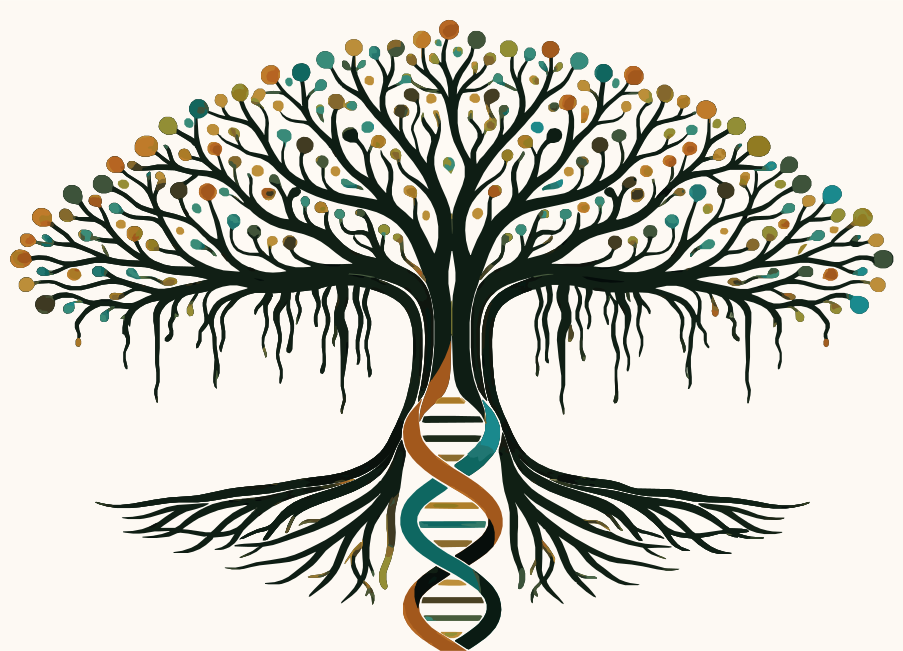
The banyan tree doesn't grow like other trees. It sends aerial roots down from its branches, and those roots become new trunks. A single banyan creates what looks like an entire forest, but every trunk is connected to the same living system.
That growth pattern maps onto the cooperative's architecture. It starts as one community (myeloma), sends roots into adjacent communities (blood cancers), and those roots become self-governing trunks (federation). One tree becomes a grove, and every part of it is connected.
The largest banyan in India covers 4.7 acres and shelters thousands of people. Across South and Southeast Asian traditions, banyans are where communities gather to make decisions together. The governance dimension, the General Assembly, the elected ethics board, the member voting, is carried in the tree's cultural meaning.
"Grove" adds something the banyan alone doesn't carry: intentionality. A grove is a small, cultivated gathering of trees, not a wild forest. It signals a community that chose to come together.
Want to be part of this story?
Banyan Grove is looking for founding members who want to shape what comes next. Your voice, your vote, your cooperative.
Become a founding member